
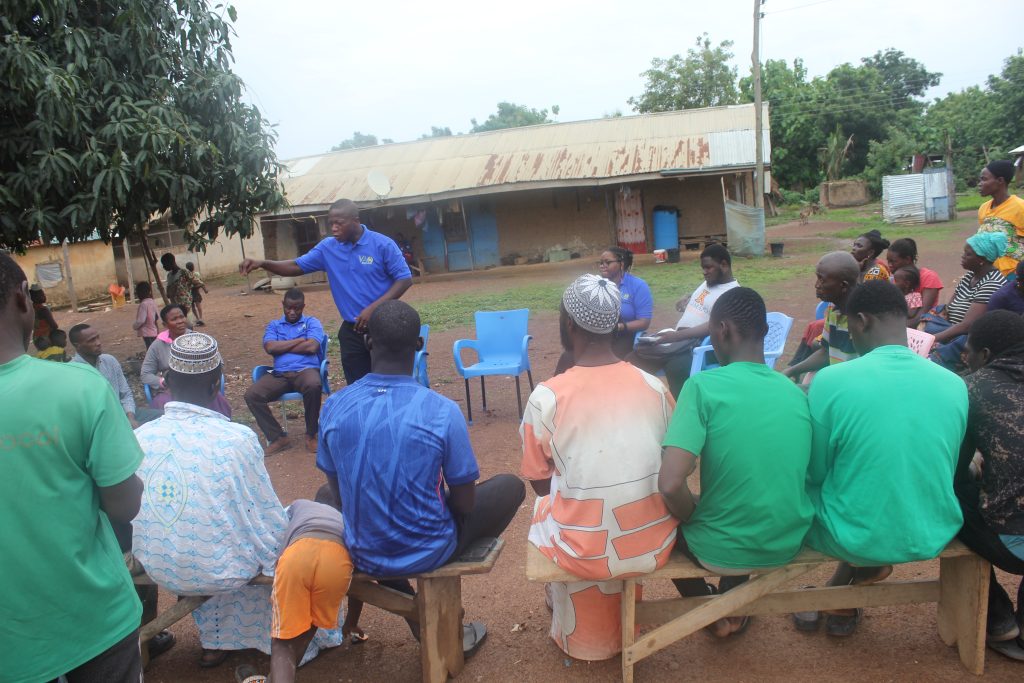
For many people, access to water is simply a matter of turning on a tap, walking to a nearby standpipe, or drawing water from a functioning borehole. But in many rural communities, access to safe and reliable water is much more complex. Behind every functioning—or non-functioning—water point are questions about management, maintenance, financing, accountability, community participation, and local ownership.
This reality became clear during our recent engagement with the Ofosu community as part of the Strengthening Community-Based Management for the Sustainability of Rural Water Services project, implemented by VAO with support from the Grundfos Foundation – PDJF.
Looking beyond the water points
Our team visited Ofosu to understand not only the physical condition of the community’s water systems, but also what happens behind them. Who is responsible for managing the water systems? How are decisions made? How does the community contribute towards the cost of water? What happens when a borehole breaks down? Are there systems in place to collect and manage funds for repairs and maintenance?
These questions are important because a water system does not become sustainable simply because it has been constructed or rehabilitated. Sustainability depends on the people, structures, resources, and systems that keep that infrastructure functioning over time.
Ofosu currently has eight boreholes, including two mechanised water systems, managed by a seven-member Water Committee. However, only four of the eight boreholes are currently functional. This means that half of the community’s boreholes are not providing water at the time of our assessment. For a community that depends heavily on these facilities, this is more than an infrastructure challenge. It can affect how far people have to travel to collect water, how much time households spend fetching water, and the reliability of water available for domestic needs, schools, businesses, and other community activities.
The cost of keeping water flowing
The community currently contributes approximately 20 pesewas per gallon towards water services. Community contributions such as these are important because rural water systems require resources long after construction is completed. Pumps and other components eventually require repairs, replacement parts, servicing, and routine maintenance.
However, collecting contributions is only one part of the equation. The community currently does not have a dedicated bank account for managing water-related funds. This presents an opportunity to strengthen financial management and accountability within the local water management structure.
A transparent and well-managed financial system can help communities keep track of revenues, plan for maintenance, respond to breakdowns, and build confidence among water users. The objective is not simply to collect money. It is to establish a system where community members understand how much is collected, how funds are managed, what they are used for, and how those resources contribute to keeping their water systems functional.
Behind the numbers are real people
It is easy to look at the figures—eight boreholes, four functional systems, seven committee members, and a 20-pesewa contribution—and see them simply as project data.
But these numbers tell a much bigger story.
- They tell us about families who depend on these water points every day.
- They tell us about women and girls who often carry a significant responsibility for collecting household water.
- They tell us about children whose time and daily routines can be affected when water is not readily available.
- They tell us about community volunteers who take on the responsibility of managing public water infrastructure, often with limited resources and technical support.
- And they tell us that providing infrastructure is only the beginning.
Strengthening community ownership
We believe that communities must be at the centre of decisions concerning the water systems they depend on. Our engagement in Ofosu is therefore not simply about identifying broken boreholes. It is about understanding the wider system around those boreholes. This includes strengthening Water Committees, improving financial management, promoting accountability, supporting routine maintenance, encouraging inclusive decision-making, and ensuring that women and other community members have meaningful opportunities to participate in water governance. When communities have the knowledge, structures, resources, and confidence to manage their water systems, they are better positioned to respond when challenges arise.
From assessment to action
The findings from Ofosu, together with assessments from other communities, are helping us identify practical areas for intervention under the project. Our goal is to move beyond a model where communities wait for external actors to respond whenever a water system breaks down. Instead, we want to contribute to stronger community-based systems where local structures are equipped to manage, monitor, maintain, and advocate for reliable water services.
This requires collaboration.
It requires communities, local authorities, traditional leaders, technical institutions, water management structures, and development partners to work together. It also requires us to listen to communities and understand their realities before designing solutions.
Building systems that last
The challenge of rural water access is not solved when water begins flowing from a borehole. The real measure of success is whether that water continues to flow months and years later. That is why our work focuses not only on infrastructure, but also on the systems and people responsible for sustaining it.
Through our partnership with the Grundfos Foundation – PDJF, we are working with rural communities to strengthen community-based water management and contribute to more reliable and sustainable rural water services.
Ofosu reminds us that sustainable water access is about much more than pumps, pipes, and boreholes. It is about people, participation, accountability, financing, local leadership, and long-term ownership.
By listening to communities, understanding their challenges, and strengthening the systems they already have, we can help build water services that are not only functional today, but have a better chance of serving communities for generations to come.Understanding the Realities Behind Water Access in Ofosu 💧
